

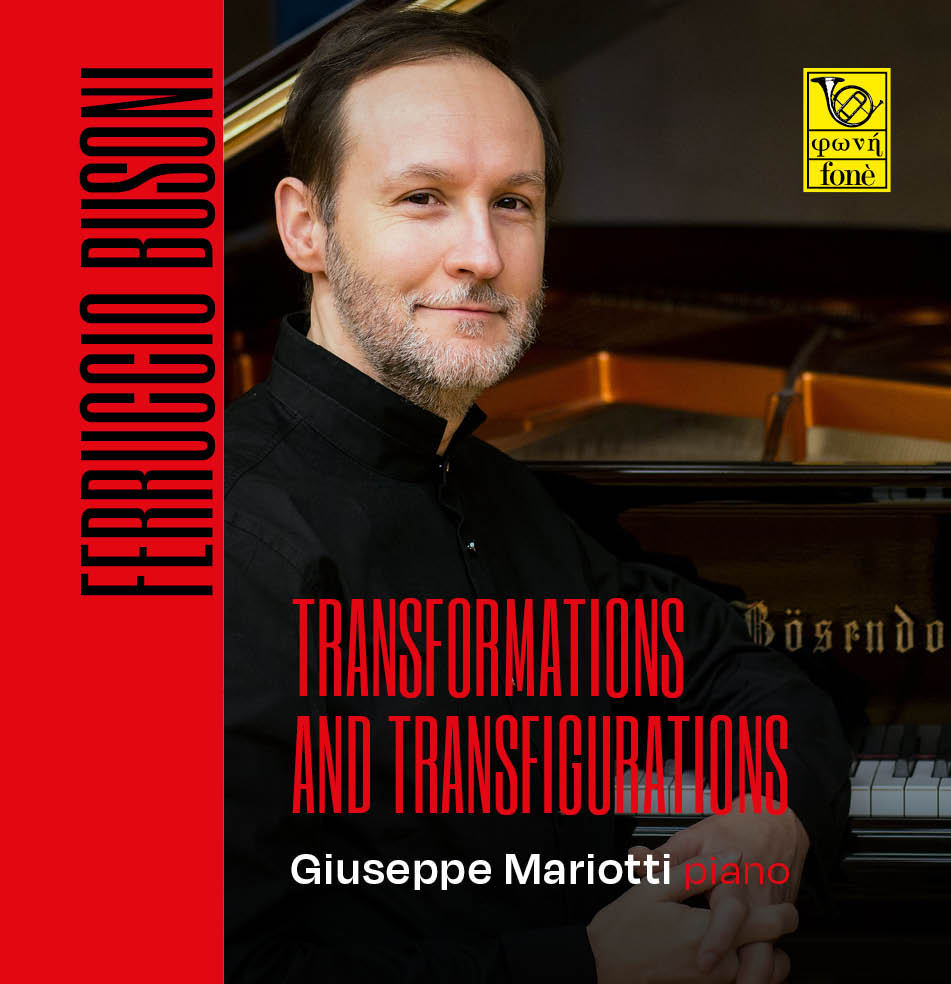
TRANSFORMACIÓN Y TRANSFIGURACIONES | Busoni, Mariotti
Fonè
Genere musicale: Clásica
En existencias
No se pudo cargar la disponibilidad de retiro
SKU:DSD9512
TRANSFORMATION AND TRANSFIGURATIONS
Ferruccio Busoni
Available in: DSD, Hi-Res Audio
Track list:
1 Sonatina Brevis. In signo Johannis Sebastiani Magni Kind. 280 (1918)
4 Elegien Kind. 249 (1907)
2 Nr. 2 All’Italia. In modo napolitano (Andante barcarolo)
3 Nr. 1 Nach der Wendung. Recueillement (Sostenuto, quasi Adagio)
4 Nr. 4 Turandots Frauengemach. Intermezzo (Andantino sereno - Più vivo e distaccato e ritmato)
5 Nr. 7 Berceuse (Andantino calmo)
6 Sonatina super “Carmen” Kind. 284 (1920) Kammer-Fantasie über Bizets Carmen
7 Choral Vorspiel über ein Bachsches Fragment Kind. 256a (1912)
8 Nuit de Noel. Esquisse pur le piano Kind. 251 (1908)
9 Toccata. Preludio - Fantasia - Ciaccona Kind. 287 (1920)
Quasi Presto, arditamente - Sostenuto, quasi Adagio - Allegro risoluto
Notes
The Leonardesque figure of Ferruccio Busoni stands imposingly in the musical landscape straddling the two centuries. A frantic activity as a man and a musician characterized his entire life, and his universal genius allowed him to reach absolute artistic heights, even if often unrecognized. His virtuosity, impressive in speed and power but never ostentatious or an end in itself, and his avant-garde and highly original musical imagination were legendary. From a young age, he was adored by the public, often baffling critics. His compositions, especially the later ones, are among the most significant and brilliant of his time: not only his piano works but also, and above all, those for orchestra and the operatic stage had a considerable influence on an entire generation of musicians. He sincerely strove to disseminate the works of his contemporary composers (such as Arnold Schoenberg, who succeeded him in the composition chair at the Musikakademie in Berlin) through performances, revisions, and critical articles. His literary background and subtle, acute mind enabled him to prepare librettos for his own operas and maintain epistolary relationships with the leading figures of his time, in addition to publishing several fundamental writings. The most significant of these, the Sketch of a New Esthetic of Music from 1907, contains brilliant insights into the dodecaphonic system, microtonality, new notation systems, and even hints of electronic music. He was also an inspiration for new instruments, such as the Viennese Bösendorfer Imperial model piano used for this recording, and originally built for him. The years from 1895 to 1907 mark a period of reflection in Busoni's piano output. His considerable commitments as a concert pianist almost overshadowed his composing, yet they fostered a new language, expressed for the first time in the Elegien. With these, the most fruitful and stimulating artistic period began, which Busoni himself called his "third style," and whose works are no longer marked by an opus number. The new expressive means of the Elegien stem from late-Romantic Brahmsian and Lisztian sonorities, refined, however, by new, brilliant insights of an Impressionistic and Expressionistic character. The sonic experiments, simple tonal chords juxtaposed with jarring dissonances, pure tonality alongside bitonality, constitute the major revelation of the Elegien. All'Italia, a tribute to his native country rich in popular song citations, shows the expressive use of dissonances, superimposed tonalities, and the juxtaposition of shifting, almost Debussyian pianistic colors (for this recording, the unpublished version of the finale prepared for Egon Petri in 1917 was used). The Intermezzo Turandots Frauengemach (Turandot's Harem) is one of Busoni's most famous pieces. The celebrated melody of "Greensleeves," with its ambiguous tonal character, is well suited to the new musical conceptions. Nach der Wendung (After the Transformation), similarly, expresses its enigmatic nocturnal character through the tension released by the alternation of the very distant keys of C and F-sharp throughout the piece. The Berceuse offers a further glimpse into Busoni's aesthetic universe: the concept of eternity, of the so-called "Omnipresence of Time." Close to the Elegien is Nuit de Noël, with its Impressionistic colors, imitations of bells, and Christmas carols. In 1910, Busoni's largest and most important piano composition, the Fantasia Contrappuntistica, was published, based on J. S. Bach's Art of Fugue. The Choral Vorspiel über ein Bachsches Fragment (Chorale Prelude on a Bach Fragment) from two years later represents a kind of smaller version of the Fantasia Contrappuntistica, based roughly on the same themes but of minimal dimensions. By the composer's own admission, the piece was conceived more for didactic purposes than for public performance. The term Sonatina refers to their size and form, not their difficulty. The return to simple and clear compositional schemes (codified by Busoni in his idea of "new classicism") and the often intimate character of the Sonatinas are in stark contrast to his earlier compositions. The Sonatina Brevis. In signo Johannis Sebastiani Magni is in fact a free arrangement of the Fantasy and Fugue in D minor BWV 905, almost a homage to the great Johann Sebastian on the margins of Busoni's gigantic work of revising Bach's clavier works for Breitkopf in those years. The most famous of the Sonatinas, the Sonatina super "Carmen" has nothing in common with Lisztian paraphrases on opera arias. Bizet's famous melodies are not debased or vulgarized, but rather treated as autonomous themes within the free sonata form. A subtle irony and sense of bitterness permeate the brilliant musical texture: the tragic and ironic ending is singular. The last compositions are closely related to Busoni's unfinished opera, Doktor Faust, in which themes were often developed and matured in his piano works. The Toccata is his last important work for piano. The piece is imbued with the themes and strong, dark hues of Doktor Faust; the tripartite structure consists of monolithic, well-defined sections, in which it is not difficult to recognize Faustian (Prelude) and Mephistophelean (Ciaccona) aspects juxtaposed with lyrical ones. The severity and nervous tension, combined with incredible technical difficulty, make the Toccata one of the absolute pinnacles of Ferruccio Busoni's output. The Frescobaldian motto inscribed next to the title is a warning to performers, whose truth was well known to Busoni: "It is not without difficulty that one reaches the end."
Giuseppe Mariotti
Share
-

Entrega de productos digitales
Información de entregaLos productos digitales se entregan a través del sitio y por correo electrónico con un enlace de descarga.
-
Escribe una reseña
Arriba puedes dejar una reseña del producto que has comprado. Nos encantará conocer tu opinión.
