


NIKITA MAGALOFF: PIANO SCHUBERT | Magaloff
Fonè
Genere musicale: Clásica
En existencias
No se pudo cargar la disponibilidad de retiro
SKU:DSD8708
NIKITA MAGALOFF
Schubert Piano
Available in: DSD, Hi-Res Audio
Track list:
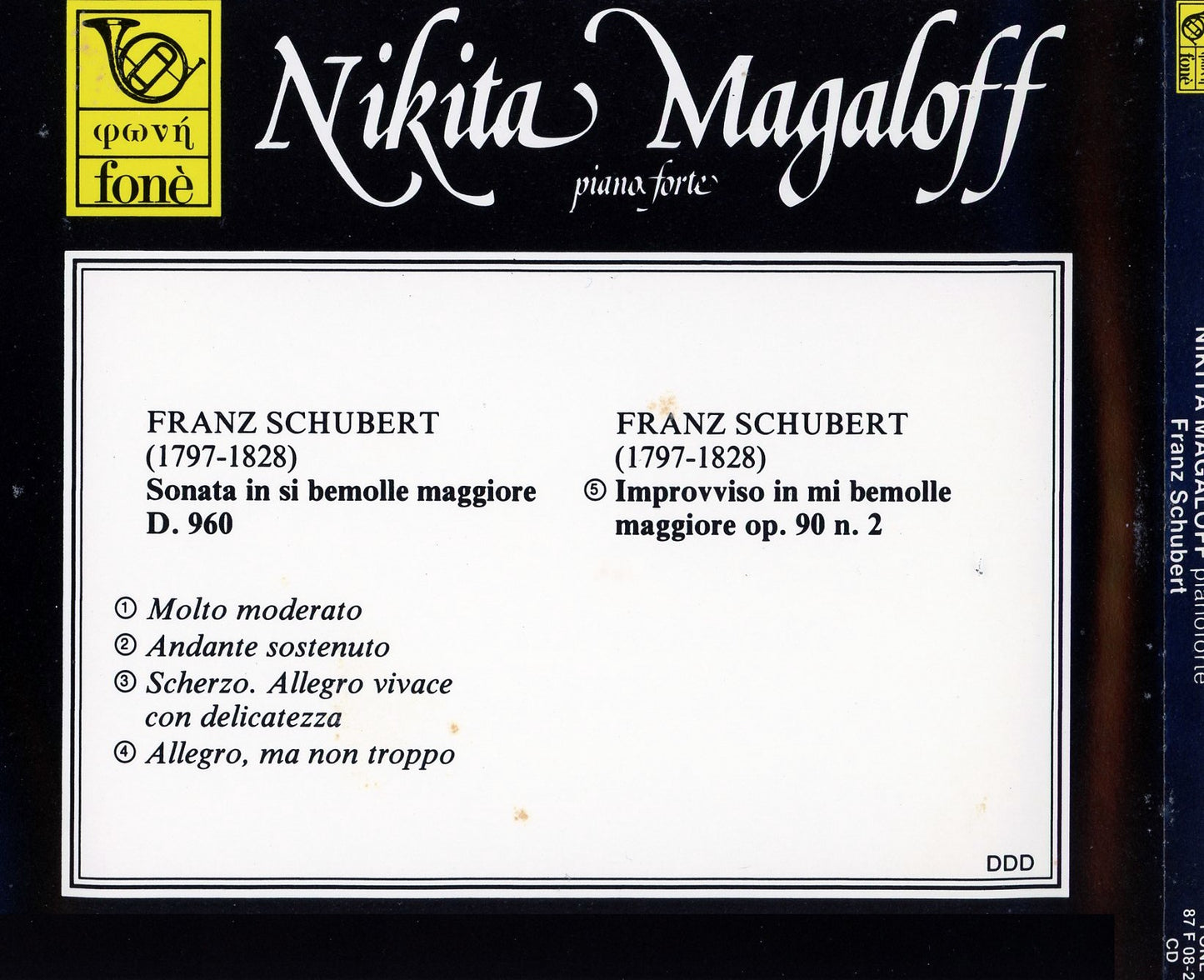
FRANZ SCHUBERT (1797-1828)
Sonata in B-flat major D. 960
1. Molto moderato
2. Andante sostenuto
3. Scherzo. Allegro vivace con delicatezza
4. Allegro, ma non troppo
FRANZ SCHUBERT (1797-1828)
5. Impromptu in E-flat major op. 90 no. 2
Notes
Recorded on May 23, 1986, at Teatro Donizetti, Bergamo; two-microphone setup with field effect (Studio Fonè).
Recording engineer: Giulio Cesare Ricci.
Production director: Giulio Cesare Ricci
NIKITA MAGALOFF piano
Born in St. Petersburg in 1912, he began his studies in Finland (where he had taken refuge with his family after the 1917 revolution) under the guidance of Alexander Siloti, a pupil of Liszt and cousin and teacher of Rachmaninoff. He later moved to Paris, studied with Isidor Philipp, graduating at the age of 17 with a Premier Grand Prix. On this occasion, Maurice Ravel said of him: «A great, truly extraordinary musician has been born». He achieved his first international successes with violinist Joseph Szigeti and, after the interruption of the war years, was one of the first artists to play in Paris and then, in 1947, to give concerts in the United States. Numerous significant events marked his career, including the first performance of Prokofiev's «Seventh Sonata», the performance of Stravinsky's «Capriccio» under the composer's direction, tours in Europe, the USA, Japan, and Israel, frequent and regular presence on the juries of the most prestigious international competitions (Leeds, Warsaw, Brussels, Lucerne), attentive as he was to the emergence of new talents among the younger generations. He has recorded music by Liszt, Tchaikovsky, Weber, Stravinsky, Brahms, Granados, and, most recently, for Philips, the complete works of Chopin, an author of whom Nikita Magaloff is among the unsurpassed interpreters, a work he also presented, in cycles of five recitals, in all the most important European cities.
Franz Schubert (1797-1828) - Sonata in B-flat major D. 960.
The Sonata in B-flat D. 960 is the last and undoubtedly the most important of Schubert's sonatas. From the surviving manuscript, we can precisely determine the date the sonata was completed: September 26, 1828. Less than two months later, on September 19, Schubert would conclude his brief earthly existence. He intended to dedicate these last creations to the celebrated virtuoso J.N. Hummel, but by the time the Sonatas finally saw the light ten years later, Hummel too had passed away. Thus, Diabelli, on his own initiative, dedicated them to Schumann, who had the merit of always believing in Schubert's genius and following the fate of his works (it was he, in fact, who rediscovered the manuscript of the Symphony in C major). This Sonata combines the beauty of its thematic material with a truly surprising formal fluidity. The first movement, with its solemn opening, is one of the broadest and most serene written by Schubert and appears devoid of those strong contrasts that usually characterize the initial movement. It should be noted in this regard that Schubert, even in his best moments, uses a less varied style of writing than Beethoven; his attention to the sonata form is also animated by less "intellectual curiosity". Yet, Schubert still manages to be original. In this first movement, for example, he achieves fascinating effects by presenting the theme against a harmonic background that changes each time, with tonal and expressive highlights of great effectiveness. This procedure does not greatly benefit the compactness of the work, but it must be acknowledged that it is precisely a typically romantic symptom to focus attention on a beautiful detail, rather than globally on the formal organization. After this broad and discursive Molto moderato movement, punctuated by pauses and trills in the bass part, recalling distant drum rolls, Schubert in the subsequent Andante sostenuto unfolds his intense lyricism, offering an amplified and solemn version of the Lied "Ständchen" (Serenade) written a few months earlier. Of note is the affinity of the motif appearing in the central section with the initial theme of the Sonata (Radcliffe) and, in the first and third sections, the use of the resonance pedal and the crossing of hands that allow different registers and timbres to resonate simultaneously: a technical solution rich in consequences that would extend to the impressionists (Rattalino). Another derivation from the thematic material of the first movement is found in the Allegro vivace con delicatezza (third movement), which is structured as a Scherzo with a rapid and delicate dance-like gait and a more compact Trio that has the appearance of a delightful "exercise" with a syncopated rhythm. The finale is a brilliant Rondò in which the vigorous flow of the discourse is periodically interrupted by a single note, a sustained G, which imposes a kind of brake on the main theme. Contrasting insertions are achieved with lyrical interludes and more dynamic and strong passages in the high register of the instrument. The conclusion with a spirited Presto closes this highly original last Schubertian creation which, despite the musical quality of the material with which it is shaped, has sometimes aroused reservations and misunderstandings.
Anna Bergonzelli
Share

-

Entrega de productos digitales
Información de entregaLos productos digitales se entregan a través del sitio y por correo electrónico con un enlace de descarga.
-
Escribe una reseña
Arriba puedes dejar una reseña del producto que has comprado. Nos encantará conocer tu opinión.
