


NIKITA MAGALOFF: PIANO | Magaloff
Fonè
Genere musicale: Clásica
En existencias
No se pudo cargar la disponibilidad de retiro
SKU:DSD8707
NIKITA MAGALOFF
Piano
Available in: DSD, Hi-Res Audio
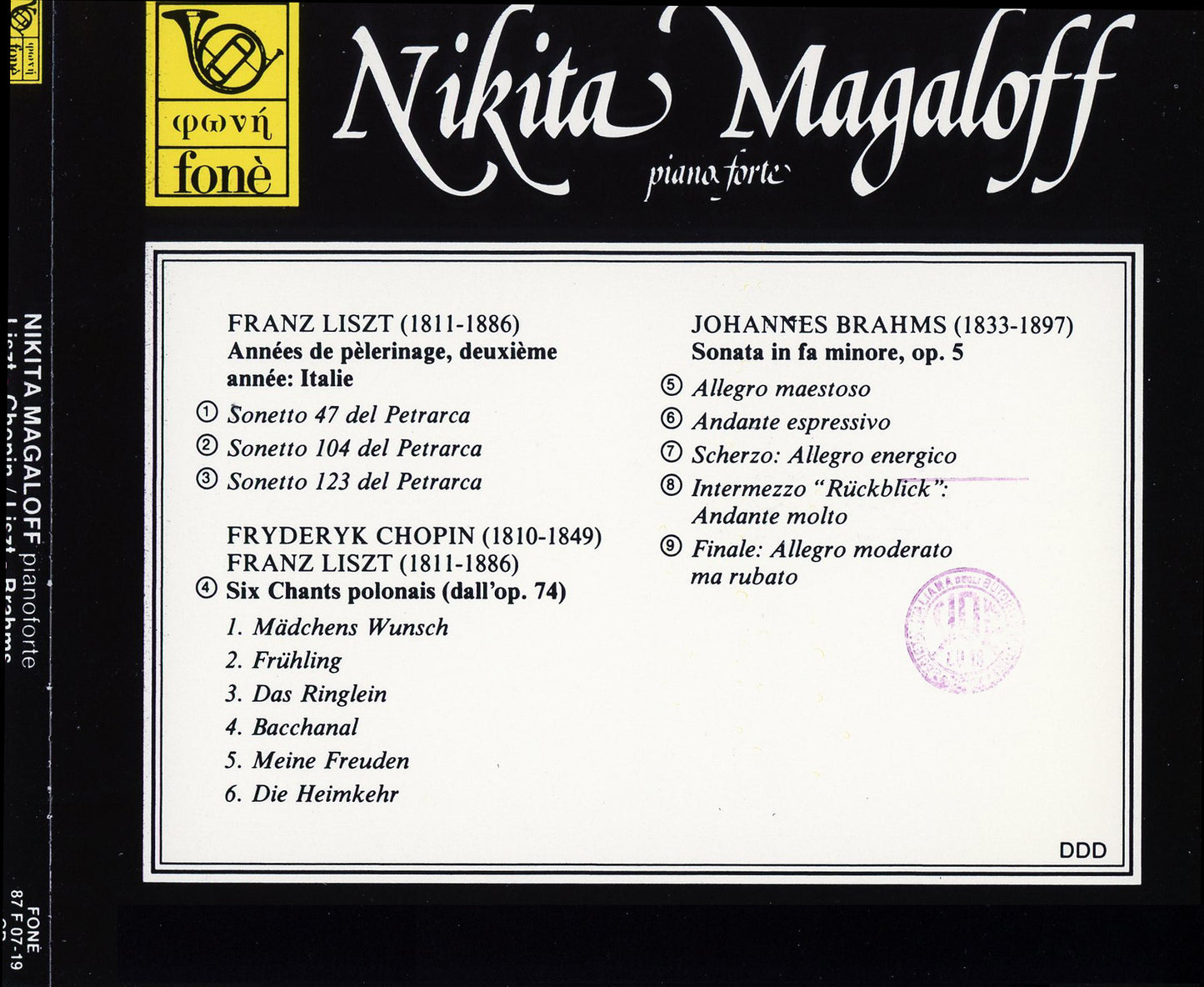
Track list:
F. LISZT (1811-1886)
Années de pèlerinage, deuxième année: Italie
1. Sonetto 47 del Petrarca
2. Sonetto 104 del Petrarca
3. Sonetto 123 del Petrarca
F. CHOPIN (1810-1849)
F. LISZT (1811-1886)
4. Six Chants polonais (from Op. 74)
Mädchens Wunsch
Frühling
Das Ringlein
Bacchanal
Meine Freuden
Die Heimkehr
J. BRAHMS (1833-1897)
Sonata in F minor, Op. 5
5. Allegro maestoso
6. Andante espressivo
7. Scherzo: Allegro energico
8. Intermezzo “Rückblick”: Andante molto
9. Finale: Allegro moderato ma rubato
Notes
Recorded on May 21, 1986, at Teatro Grande, Brescia; bi-microphone field effect configuration (Studio Fonè).
Recording engineer: Giulio Cesare Ricci.
Production director: Giulio Cesare Ricci.
NIKITA MAGALOFF
Born in St. Petersburg in 1912, he began his studies in Finland (where he had taken refuge with his family after the 1917 revolution) under the guidance of Alexander Siloti, a student of Liszt and cousin and professor of Rachmaninoff. He later moved to Paris, studying with Isidor Philipp and graduating at the age of 17 with a First Grand Prix. It was on this occasion that Maurice Ravel said of him: "A great musician, truly extraordinary, has been born." He achieved his first international successes with violinist Joseph Szigeti and, after the interruption of the war years, was one of the first artists to play in Paris and then, in 1947, to give concerts in the United States. His career saw countless significant events, including the first performance of Prokofiev's "Seventh Sonata," the performance of Stravinsky's "Capriccio" under the composer's direction, "tours" in Europe, the USA, Japan, and Israel, and frequent and regular presence on the juries of the most prestigious international competitions (Leeds, Warsaw, Brussels, Lucerne), attentive as he was to the emergence of new talents among the younger generations. He recorded music by Liszt, Tchaikovsky, Weber, Stravinsky, Brahms, Granados and, more recently, for Philips, the complete works of Chopin, an author of whom Nikita Magaloff is one of the unsurpassed interpreters, a work he also presented in cycles of five recitals in all the major European cities.
Frédéric Chopin (1810.1849) / Franz Liszt (1811-1886)
Six Chants Polonais (from Op. 74)
The second "Year of Pilgrimage" dedicated to Italy is considered the most important of the three as a whole. The entire Year was published in 1858, preceded by two drafts dating back to '37 and '49 respectively. This recording features the three Petrarch Sonnets, whose entry into Liszt's oeuvre dates back to around 1838 as Lieder for voice and piano, and which were then excellently transcribed for solo piano. On this occasion too, Liszt reveals exceptional mastery in the art of transcription, understood as an authentic recreation of a new writing and language, in relation to the new expressive medium. Exemplary is the adherence to the poetic texts that sing of the first encounter with the beloved woman (Sonnet 47), the unhappy love and intimate conflicts of the poet's soul (Sonnet 104), and the appearance of the angelic woman as a symbol of ideal beauty (Sonnet 123). 16 Polish songs from Chopin's Op. 74 (S. 480), composed in 1847, were revised and published in '60. They are dedicated to Princess Maria von Hohenlohe, daughter of Princess Carolyne Sayn-Wittgenstein. These are six of the 17 songs that make up Chopin's original work composed between 1829 and '47 and published ten years later. As with Schubert's Lieder, Liszt's choice falls on texts of greater emotional impact and melodic beauty, which, as always, Liszt knows how to connect with discreet tonal links and subtle transitions of atmosphere. In the order chosen by Liszt, the Songs are: 1. Maiden's Wish, which also opens Chopin's collection; 2. Spring (Op. 74 No. 2); 3. The Ringlet (Op. 74 No. 14); 4. Toast (Op. 74 No. 4); 5. My Joys (Op. 74 No. 12); 6. The Bridegroom (Op. 74 No. 15). Once again, Liszt is appreciated as a transcriber, respecting Chopin's intimacy and maintaining a light hand in the piano writing.
Johannes Brahms (1833-1897) Sonata in F minor, Op. 5
In October 1853, Schumann enthusiastically hailed the rising star of young Brahms, then twenty years old, in the pages of the "Neue Zeitschrift für Musik". It was precisely during that period that the Hamburg composer completed, by composing the first, third, and fifth movements (the second and fourth had already been composed before the fateful arrival at Schumann's house), his Sonata in F minor, destined to remain his last, as well as the most important of his three for solo piano. The signature "Kreisler iunior" at the bottom of the manuscript says much about his moral commitment to continue in the furrow traced by the author of Kreisleriana... The Sonata is dedicated to Countess von Hohenthal. The unusual five movements seem to hark back to the archaic tradition of "Divertimenti". The sequence of movements alternates fast and slow tempi, the latter linked by the identity of the thematic material. And even within the same movement, particularly the first, entirely based on the continuous flowing sound of the passionately vibrant main theme, we discover Brahms already laying the foundations of that particular compositional technique - called continuous development - which would become characteristic of his Symphonies. Also evident here, as in the rest of the Sonata, is the search for an almost orchestral sonic depth. The nocturnal, contemplative romantic atmosphere of the celebrated Andante connects to the equally suggestive Adagios of the Sonatas Op. 1 and 2 and redeems, with its intense but pure and restrained pathos, the sentimental tone of Sternau's verses preceding it: Der Abend dämmert, das Mondlicht scheint, Da sind zwei Herzen in Liebe vereint Und halten sich selig umfangen. (Evening falls, the moonlight shines: here are two hearts united in love, and they remain happily embraced). Verses that reflect the solitary existential moment Brahms was experiencing at the time. The rhythmically distinct Scherzo is a typical Brahmsian creation, while in the Trio, a nostalgic cantabile prevails. Unlike classical tradition, Brahms inserts an Intermezzo at this point, as the fourth movement, which he titles "Rückblick" ("Retrospect, Remembrance"), echoing, in the darker key of B-flat minor, the theme of the Andante. The finale, structured as a Rondo, has a rhythmically sharp main theme alongside which, with a singular effect, are two secondary, lyrically cantabile motives. The second of these motives (in D-flat) will lead to extensive polyphonic and contrapuntal elaboration (even then, these procedures proved congenial to Brahms's severity). Finally, a brilliant coda where the main theme also reappears, concludes this monumental work in a climate of triumphant euphoria.
Anna Bergonzelli
Share

-

Entrega de productos digitales
Información de entregaLos productos digitales se entregan a través del sitio y por correo electrónico con un enlace de descarga.
-
Escribe una reseña
Arriba puedes dejar una reseña del producto que has comprado. Nos encantará conocer tu opinión.
