

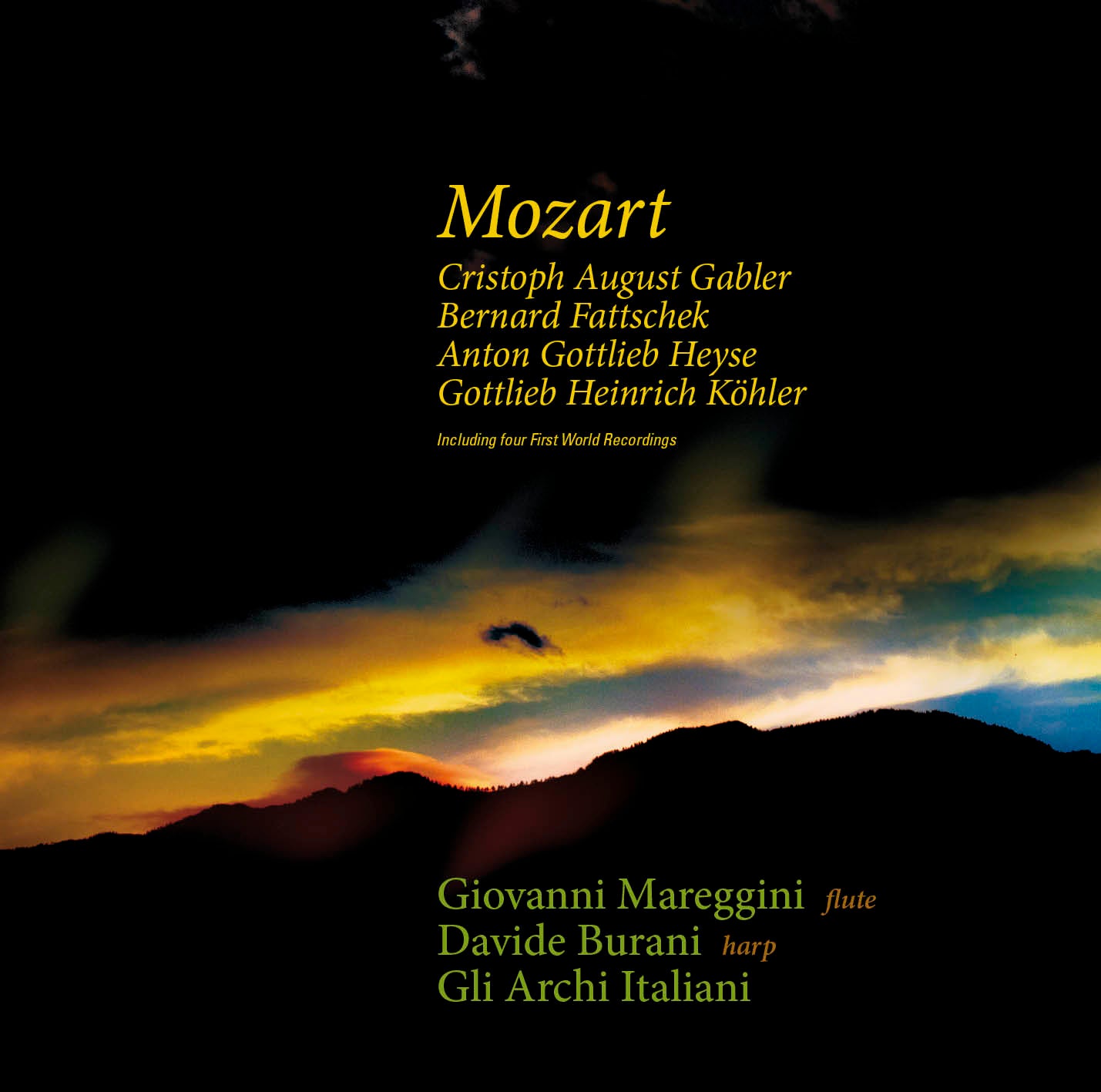
MOZART, Gabler, Fattschek, Heyse, Köhler - Mareggini, Burani, Gli Archi Italiani
Velut Luna
Genere musicale: Folk and Classica
In stock
Couldn't load pickup availability
SKU:CVLD211CD
MOZART, Gabler, Fattschek, Heyse, Köhler - Mareggini, Burani, Gli Archi Italiani (CVLD211)
Performer: Giovanni Mareggini, Davide Burani, Gli Archi Italiani
Production: Velut Luna | Executive producer: Marco Lincetto |
Artistic direction: Anna Pasetti | Recording & Mastering engineer: Marco Lincetto |
Editing engineer: Michele Sartor | Design: l’image | Photo: Benito Vanicelli |
English text: Guido Mariani | Marketing: Francesco Pesavento |
Sales Manager: Moreno Danieli & Patrizia Pagiaro |
Press Agent: Emanuela Dalla Valle | World Wide Contacts: Cristiana Dalla Valle
Tracks
01 - Mozart - KV299 - Allegro
02 - Mozart - KV299 - Andantino
03 - Mozart - KV299 - Allegro
04 - Gabler - Andante con var op34
05 - Fattschek - Sonatina op3 - Allegro
06 - Fattschek - Sonatina op3 - Adagio
07 - Fattschek - Sonatina op3 - Allegretto con var
08 - Heyse - Sonata op4 - Allegro moderato
09 - Heyse - Sonata op4 - Tempo di minuetto
10 - Heyse - Sonata op4 - Presto
11 - Kohler - Sonata op59 - Allegro con spirito
12 - Kohler - Sonata op59 - Romanza, Andantino
13 - Kohler - Sonata op59 - Andante con var
Notes
Mozart: 24bit/88kHz digital recording made at Chiesa della Madonna dell’Uliveto
- Montericco di Albinea (Reggio Emilia) on January 4, 2011
Gabler/Fattschek/Heyse/Köhler: 24 bit/88kHz digital recording made at
MagisterAreaStudios, Preganziol on March 29, 2011
Davide Burani plays a Salvi harp, DIANA model.
Wolfgang Amadeus Mozart (Salzburg, 1756-Vienna, 1791) composed his Concerto for Flute, Harp and Orchestra K299 during his second stay in Paris in 1778, commissioned by Adrien-Louis de Bounières, Duke of Guines. Very close to Queen Marie Antoinette, Guines was French ambassador to London for several years, but was forced to return to Paris after a major financial scandal in which he was involved due to his secretary (the title of duke was granted to him as compensation, thanks to the queen's intercession). Composed in three movements (Allegro, Andantino and Allegro), the Concerto is characterized by a wealth of thematic elements. The first movement, in C major, opens with a joyful arpeggio
in full orchestra on the fundamental chord, followed by a broken scale that quickly leads to the exposition of strings and oboes. The second theme (still in the tonic key) is introduced by two long notes from the horns and presents a gallant character that elegantly contrasts with the martial and joyful character of the first theme. The entry of the two solo instruments is preceded by a series of fast triplets
from the strings that recall the beginning of the "Jupiter" Symphony K551 (from 1788, exactly ten years after this Concerto). Flute and harp then reprise the first theme, re-elaborating and enriching it with continuous dialogue, until reaching the classical modulation to the dominant key. Here the flute is entrusted with a cantabile and lyrical phrase, while the harp has the task of accompanying, in a truly chamber music dimension; then follows a virtuosic passage by the harp that leads to the reprise of the second theme in G major, which is in turn re-elaborated. A new cantabile motif from the flute in A minor, followed by the re-proposition of the first theme by the harp, marks the beginning of the most evocative (and perhaps most "French") part of the first movement, with a moment of very intense dialogue between the two instruments. The reprise of the two main themes, the cadenza of the soloists and a brief coda conclude the movement. The Andantino (in F major) is perhaps the most famous movement of the entire Concerto. Composed in bipartite form, with a streamlined orchestration for strings alone, this movement shines with melodic richness and the flute's expansive cantability, accompanied by the delicate arpeggios and virtuosity of the harp. The concluding Allegro is
constructed in sonata-rondo form. The initial exposition begins with a "piano" from the strings alone, followed by the oboes, which is soon contrasted by a sudden and very dynamic "forte" from the strings, with repeated notes and fast figurations. The chiaroscuro contrast between "piano" and "forte" constitutes one of the most important elements of this movement, contributing decisively to its vivacity. Here too, the entry of the soloists marks a thematic re-elaboration in a dialogue form, with the flute once again standing out for the cantability of the phrases entrusted to it, balancing the more decidedly virtuosic musical writing of the harp. It is interesting how Mozart here alternates newly conceived melodic phrases with previously proposed motifs, creating in the listener the impression of being faced with a true Rondo. The twenty-two-year-old Wolfgang arrived in France at the beginning of March 1778, accompanied by his mother, hoping to gain the queen's protection, known for welcoming artists and musicians from all over Europe to her court. However, Marie Antoinette was at that time dealing with her first pregnancy and, despite the support of the Duke of Guines, she never received him. He was nevertheless offered the position of organist at Versailles, which he refused, despite his father's advice who considered it a secure job and a good way to stay in contact with the court and access the queen's entourage.
Those were the years of the harp's greatest splendor in France, which had already become the favorite instrument of the French aristocracy since the 1760s. Meanwhile, important musical pages had already been dedicated to the transverse flute, but these two instruments had rarely met until then. The enlightened commission of the Duke of Guines, an amateur flutist who loved to play with his harpist daughter (who also took composition lessons from Mozart), gave a decisive impulse to the birth of the repertoire for flute and harp which, from then on, progressively began to be enriched with works by French, Italian, but especially German authors.
Share
-

Physical product shipping
Shipping policyFree shipping in Italy and EU countries on orders from €95. For the UK, USA, Canada and the rest of the world, see the shipping policy.
-
Digital product delivery
Delivery informationDigital products are delivered through the site and by email with a download link.
-
Write a review
You can leave a review of your purchase above. We’ll be glad to hear your opinion.
