

MORSE & LIFE - BERTOGLIO
Velut Luna
Genere musicale: Classica
In stock
Couldn't load pickup availability
SKU:CVLD231CD
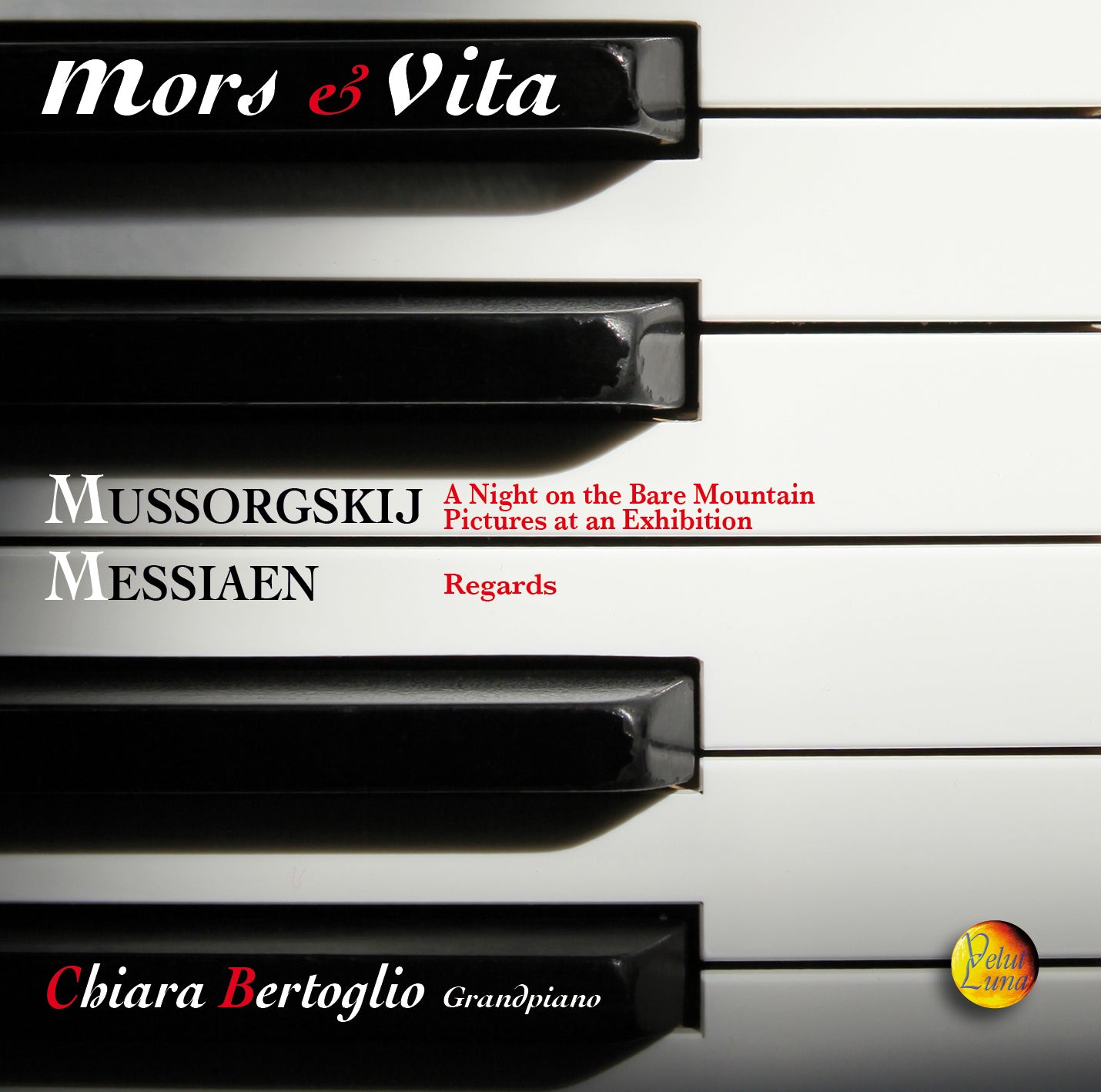
MORS & VITA (CVLD231)
Composer: M. P. MUSSORGSKIJ O. MESSIAEN
Performer: CHIARA BERTOGLIO
Available in: File HD, CD
Tracks
01 - A night on the Bare Mountain
02 - Vingt Regards sur L'Enfant-Jésus: Regard du Père
03 - Vingt Regards sur L'Enfant-Jésus: Regard de l'étoile
04 - Vingt Regards sur L'Enfant-Jésus: Première Communion de la Vierge
05 - Pictures at an Exhibition: Promenade
06 - Pictures at an Exhibition: Gnomus
07 - Pictures at an Exhibition: Promenade
08 - Pictures at an Exhibition: Il vecchio castello
09 - Pictures at an Exhibition: Promenade
10 - Pictures at an Exhibition: Tuileries (Dispute d'enfants après jeux)
11 - Pictures at an Exhibition: Bydło
12 - Pictures at an Exhibition: Promenade
13 - Pictures at an Exhibition: Ballet of the unhatched chicks
14 - Pictures at an Exhibition: Samuel Goldenberg and Schmuÿle
15 - Pictures at an Exhibition: Promenade
16 - Pictures at an Exhibition: Limoges - Le marché
17 - Pictures at an Exhibition: Catacombae (Sepulcrum romanum)
18 - Pictures at an Exhibition: Cum mortuis in lingua mortua
19 - Pictures at an Exhibition: The Hut on Fowl's Legs (Baba Yaga)
20 - Pictures at an Exhibition: The Great Gate of Kiev
Notes
Original compositions by M. P. Mussorgskij / N. A. Rimskij-Korsakov, O. Messiaen.
Chiara Bertoglio Grandpiano.
24bit/88.2 kHz original live-in-studio-recorded, in Velut Luna Studio, Preganziol, Italy, on August 5,6-2012.
Messiaen and Mussorgsky: two personalities, two styles, two completely different approaches to life, faith, and music. The first: a French composer of the twentieth century, with a musical language that blends modes of pitch and rhythm, bird songs, Indian rhythms, cryptographies and symbolism, and even rare serial passages. The second: one of the "Mighty Five" who promoted authentically Russian music at the end of the nineteenth century; one whose extraordinary talent was not confined by the academic schemes of professionalism, and maintained the sovereign creative freedom of the "dilettante," in the best sense of the word. The first: a fervent Catholic who never made a secret of his faith and how it inspired his entire musical production. The second: always in search of the infinite, perpetually tormented by doubts, constantly under the terrifying shadow of death, his true and only muse. However, as we shall see (and hear), these two opposing personalities have much in common, much more than one would expect.
It is true that Messiaen greatly admired Mussorgsky, and that his own language is indebted to that of the Russian composer. The Vingt Regards sur l’Enfant Jésus are twenty musical contemplations of the child Jesus. These are not, as one might imagine, sugary holy cards; on the contrary, they are pieces of great theological and conceptual complexity, transmitted above all through the precise symbolism of their leading motifs. Among these, we should mention the "God theme" (a series of chords that evokes His "Trinity"), which entirely informs number 1, Regard du Père, and frequently recurs in Première Communion de la Vierge; and the "Star and Cross theme," which connects the mystery of Christ's incarnation with that of His Passion (no. 2). In Première Communion, Messiaen explores the relationship between the Virgin Mary and her child during the nine months of pregnancy, assimilating the supernatural (yet also so natural) communion between mother and child with that brought to the believer by the Eucharist.
The contrast between this intimate and holy scene and the infernal Night on Bald Mountain could not be stronger. Mussorgsky's famous piece, a symphonic poem performed here in Konstantin Černov's fascinating piano transcription, portrays a witches' Sabbath in honor of Chernobog, the "black god" of Slavic mythology. It is actually a pagan cult of darkness and evil, rather than a simple magical feast: for Mussorgsky, there is a strong link between witchcraft, paganism, hell, and evil. The Sabbath concludes at the first chime of matins bells, on the feast of St. John; however, this conclusion does not appear as a clear triumph of good over evil, but rather as a truce between two equally strong armies.
It is therefore significant that a similar starting point leads Mussorgsky to a very different conclusion in Pictures at an Exhibition, a cycle composed in memory of Viktor Hartmann, Mussorgsky's painter friend, who suddenly died in the composer's presence. As mentioned earlier, the theme of death is a constant in Mussorgsky's life and work, and, naturally, it becomes particularly central here. The Pictures of the first part, interspersed with the Promenades (a musical symbol of Mussorgsky himself and his emotional reactions to the paintings) are delightful and sometimes very profound images: a terrifying gnome, the impossible serenades of the village idiot to the most beautiful girl (The Old Castle), the children's quarrel after playing (Tuileries), the heavy burden and arduous advance of Poland towards independence, symbolized by that of an oxcart in the mud (Bydło), the ballet of unhatched chicks, and the caricature of two Jews, a rich man and a beggar (Samuel Goldenberg and Schmuÿle). In the second part, however, Mussorgsky draws an astonishing journey through humanity's greatest questions. Limoges represents a market, with its thousand sounds, colors, smells: a symbol of life, vitality, encounters, upon which, like an axe, death falls in Catacombae (think of Hartmann's sudden death). Mussorgsky's musical alter ego, the Promenade theme, resounds under spectral tremolos, almost signifying the composer's own death. Baba-Yaga, a horrible witch, is also here a symbol of evil, hell, and man's ancestral fears. Her apparent triumph, however, is swept away by the Great Gate of Kiev, beneath which a religious procession unfolds: we hear the sound of bells, the organ, the choirs of priests; the Promenade theme, portrayed as "dead" in Catacombae, is found here "resurrected." It is life beyond death, the possibility of maintaining our relationships with those we loved through death, beyond death, and forever.
Chiara Bertoglio
Share
-

Physical product shipping
Shipping policyFree shipping in Italy and EU countries on orders from €95. For the UK, USA, Canada and the rest of the world, see the shipping policy.
-
Digital product delivery
Delivery informationDigital products are delivered through the site and by email with a download link.
-
Write a review
You can leave a review of your purchase above. We’ll be glad to hear your opinion.
