

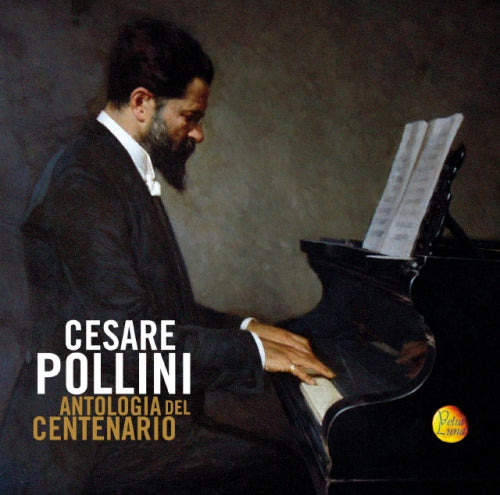
CENTENARY ANTHOLOGY - POLLINI
Velut Luna
Genere musicale: Classica
In stock
Couldn't load pickup availability
SKU:CVLD247CD
CENTENARY ANTHOLOGY ( CVLD247 )
Author : CESARE POLLINI
Performer : CONSERVATORY ORCHESTRA
TRACKLIST
1 - Scherzo in F major (1880), for orchestra
2 - Nocturne in D major (1882), for orchestra
Orestes Radish (1871-1938)
3 - Elegy “on the death of Cesare Pollini” (Andante) for strings
4 : 8 - Suite op. 3 in E major for violin, cello and piano
Allegro non troppo / Largo espressivo / Tempo di Minuet / Mesto (In the manner of a Romance) / Presto
9 : 11 - Three album sheets (1903)
Waiting (Presto) / Melancholy (Andante sostenuto quasi adagio) / First snow (Andante con moto)
12 - Nocturne (Mesto), No. 2 from Six Album Sheets (1878)
13 - Presto scherzoso No. 5 from Six album sheets (1878)
14 - Funeral March (Adagio Maestoso) in B flat minor (1874)
15 - Romance (Quasi adagio)
16 : 19 - Sonata in F minor (1874/1899)
Allegro passione / Sostenuto / Intermezzo / Finale (Energetic/Very agitated)
INTERPRETERS
Orchestra of the Conservatory “Cesare Pollini” (tracks 1/2)
Giuliano Medeossi director (tracks 1/2)
Orchestra of Padua and Veneto (tracks 3)
Pietro Billi director (tracks 3)
Andrea Vio violin (tracks 4-8)
Angelo Zanin cello (tracks 4-8)
Aldo Orvieto piano (tracks 4-8)
Maura Mazzonetto piano (tracks 9-14)
Giovanni Tirindelli piano (tracks 15-19)
Technical notes
Cesare Pollini, son of the Paduan nobleman Luigi de' Pollini, was born on 13 July 1858. He began studying piano at a very young age under the guidance of his mother Luigia dei conti de' Cassis-Faraone. In 1878, Count Pietro Suman sent some of Pollini's compositions - until then practically self-taught - to Antonio Bazzini, an illustrious composer, violinist and professor at the Milan Conservatory, who welcomed him into his class in 1880 and of whom he soon became one of the favorite students. Two years later, Pollini returned to Padua to take over the direction of the Musical Institute, founded there on 29 June 1879. On 5 December 1886, Pollini undertook a long concert tour in Germany with the violinist Antonio Freschi, also a student of Bazzini. On 2 January the duo made their debut in Munich, receiving very favorable reviews, in particular from the 'Berliner Tagblatt?. Among the pieces performed was the Suite op. 3 dedicated to Richard Strauss, who was present at the performance. The tour continued to Frankfurt, Stuttgart, Berlin, Vienna. In 1889 he was invited by the Queen to the Royal Villa of Monza to hold a concert in honor of Emperor Wilhelm II and in 1892 King Umberto I named him a knight of SS. Maurizio and Lazzaro, personally presenting him with the insignia in Monza. On January 26, 1912, Cesare Pollini died suddenly at the age of 54. The news of his death was spread by newspapers throughout Italy. The Padua institute decided to give itself a new name in memory of its director.
The half century between the annexation to the Kingdom of Italy and the First World War is a time of decadent retreat, a historical moment in which the post-unification disappointment is intertwined with the climate of despair over the awareness of Italy's cultural backwardness compared to the world beyond the Alps. For Padua too, it is a very intense and contradictory period of material and cultural reorganization, of proud quartering on traditional positions, but also of bold openings and a slow path of rapprochement with contemporary Europe. A significant presence in cultural life between the end of the nineteenth century and the beginning of the twentieth century, Cesare Pollini - in the words of Arrigo Boito - "occupied among the most select art lovers a special degree of eminence and nobility". In the many experiences acquired in his intense activity as a concert performer, composer and musicologist, Pollini had cultivated an extraordinary wealth of stimuli that he made available to the cultural life of Padua with admirable generosity. Thanks to his friendship with illustrious figures from the Italian and German musical world (the aforementioned Richard Strauss and Antonio Bazzini, but also Giuseppe Martucci, Giovanni Sgambati, Oscar Chilesotti and many others), he was passionately committed to promoting European musical culture in the Paduan area, renewing concert choices and refining the public's musical taste. Worthy of note in this regard was his commitment as organizer of the "musical mornings" at Palazzo Selvatico Estense, concert cycles whose programs were aimed at presenting the German romantic repertoire, until then practically unknown in Italy and considered unbearably boring by the public: "The concert program aroused the most serious mistrust due to the absolute exclusion of vocal pieces and the predominance of classical authors, whose names gave the shivers to the great majority of amateurs and made them foresee that terrible tedium that in similar circumstances always falls, like a nightmare, on the heads of these amateurs." Padua shared with the major centers of the Peninsula the tension between musical habits crushed by the theater and by the consumption of the salon and the pedagogical will of an elite to bring local culture and taste closer to European models. Significant in this regard is the drafting of the Terminologia musicale tedesco-italiana that Pollini will publish in 1894 by the F.lli Bocca of Turin. Numerous were also the commemorative concerts organized by the maestro in the context of the artistic program of the Paduan Institute: for the seventh anniversary of the death of Richard Wagner (1890), in commemoration of Gioachino Rossini and Giuseppe Tartini (1892), of Anton Rubinstein (1895), of Antonio Bazzini (1897), of Johannes Brahms (1898), of Giuseppe Verdi (1901), of Edvard Grieg (1908).
Share
-

Physical product shipping
Shipping policyFree shipping in Italy and EU countries on orders from €95. For the UK, USA, Canada and the rest of the world, see the shipping policy.
-
Write a review
You can leave a review of your purchase above. We’ll be glad to hear your opinion.
