

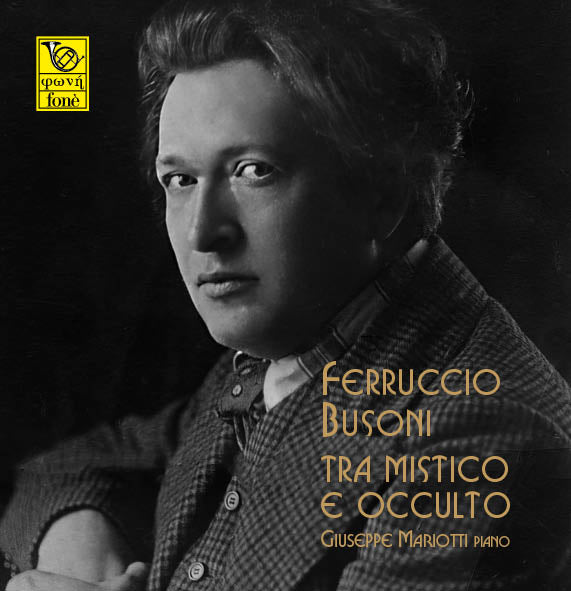
TRA MISTICO E OCCULTO | Busoni, Mariotti
Fonè
Genere musicale: Clásica
En existencias
No se pudo cargar la disponibilidad de retiro
SKU:DSD9607
BETWEEN MYSTICAL AND OCCULT
Ferruccio Busoni
Available in: DSD, Hi-Res Audio
Track list:
1 Sonatina seconda Kind. 259 (1912)
2 Sonatina in diem nativitatis Christi MCMXVII Kind. 274 (1917)
3 Toccata. Preludio - Fantasia - Ciaccona Kind. 287 (1920) Quasi Presto, arditamente - Sostenuto, quasi Adagio - Allegro risoluto
4 Berceuse (Andantino calmo) Kind. 252 (1909)
5 Fantasia contrappuntistica Kind. 256 (1910)
Note
Busoni's revolutionary 1906 essay, “Entwurf einer neuen Ästhetik der Tonkunst” (Sketch of a New Aesthetic of Music), which caused such a stir in the European musical world of those years, bears in its dedication the name of the poet Rainer Maria Rilke, "musician of words," from whose works the composer had drawn the title and character of the Elegies. Romanticism had already signaled a return to ancient mystical ideas, and with the turn of the century, a period rife with decadent expressions and tragic premonitions, mysticism found enthusiastic proponents like M. Maeterlinck, P. Claudel, and, in the German-speaking world, R. M. Rilke. Sartre wrote: "...the West was suffocating... Since it had no visible enemies, the bourgeoisie began to feed on the fear of its own shadow... there was talk of spiritualism and ectoplasms, the Beyond seemed so near...". The arcane disciplines began to exert a considerable influence on Busoni during those years. He attended seances and became interested in occultism, spiritualism, and clairvoyance. He formulated theories about the faculty of seeing ghosts: man would possess the ability to see - for very brief instants - into the future or the past. "...It would be nothing more than a momentary and uncertain glance cast - into the present or the past. Everything proceeds in the form of a circle, and so it must be for clairvoyance. It is a phenomenon analogous to what occurs in a radiotelegraphic station, which transmits to the same distance in all directions...". In a similar way, he explained his convictions regarding extrasensory perceptions: we can therefore reasonably deduce that Busoni believed in the existence of entities and forces not rationally or empirically explicable, which, however, it would be possible to know and perhaps master, in his case also through musical experience. During his American tours, Busoni came into contact with the theosophical doctrines developed in the United States at the end of the century. These advocated a path of ethical and spiritual evolution which, through the progressive purification of motives and works, leads to the realization of an ideal of mystical perfection rich in all the attributes of wisdom, serenity, beauty, and power: one can easily trace the aesthetic foundations of the "New Classicism" (Junge Klassizität), in other words, the return to simple, clear, and beautiful compositional schemes that find full expression in the Sonatina in diem nativitatis Christi MCMXVII. In May 1912, Busoni purchased Umberto Boccioni's large futurist painting "The City Rises" in Berlin. The composition of the Sonatina seconda, his most avant-garde piece which contains a quantity of mystical and occult elements, dates back to May-July of the same year. As stated in his Berlin diary, "at night, Boccioni in the music room, illuminated by the magical light penetrating from the square below, takes on a strange, magical appearance." It is not difficult to imagine the composer sitting in the dimly lit room, surrounded by Buddha statues, rare books, and "The City Rises" projecting its multicolored reflections. Just as the occult transcends spatial and temporal distinctions, through which the individual orientates himself in the real world, so Busoni often cancels bar lines, accidentals, and, especially, tonality: this realizes the manifestation in musical terms of what unfolds in the dark zones of his personality. This sensitivity to occultism and mysticism enormously enriched Busoni's language through the creation of new concepts and means of expression, and it was an essential ferment of his last creative phase, whose ultimate culmination is reached, in his piano production, by the Fantasia Contrappuntistica. Here are enclosed all the characterizing elements of Busoni's aesthetic thought. The ingenious union of modern musical language with the counterpoint of J. S. Bach's Art of Fugue generates a kind of mystical "experience" through which the inner movements of the soul gain predominance over rational thought, will, and consciousness. In a complex of daring harmonies and pure polyphony, the journey proceeds, elevating itself between moments of exaltation and mystery, visionary impulses or pensive episodes, deep meditations, and vague reflections. When music resonates, the human being is capable of acquiring a transcendental capacity that leads him to a new plane of consciousness, where the temporal world is submerged by the resonant universe. The musical work of art exists before and after it has finished resonating; it is simultaneously within and outside of time. It is this "Omnipresence of Time," also present in the Berceuse, that synthesizes the ideal of mystical ecstasy idealized by Busoni: "...we humans conceive of time as a line that starts from a point behind us and proceeds forward, while it must expand in all directions, like everything in the cosmic system...". Only with the quietness of spirit, however, can we penetrate the deepest mysteries and aspire to a higher and fuller life, which is proper to human consciousness. "Only he who looks forward has a joyful gaze," says Faust. The esoteric meaning of these principles was precisely expressed for the last time in the unfinished opera Dr. Faust, whose themes and strong colors impregnate the Toccata. The composer's high and lived spirituality made him well aware of embarking on a new path, full of consequences for 20th-century music. "Still unexhausted are the symbols / that the omnipotent genius comprehends within himself; / the work will produce a school / that for decades will mature fruitfully. / May everyone draw their own teaching from it / so that Spirit is added to other Spirit: / this is the meaning of continuous ascent / the dance will then close its circle."
Giuseppe Mariotti
Share
-

Entrega de productos digitales
Información de entregaLos productos digitales se entregan a través del sitio y por correo electrónico con un enlace de descarga.
-
Escribe una reseña
Arriba puedes dejar una reseña del producto que has comprado. Nos encantará conocer tu opinión.
