

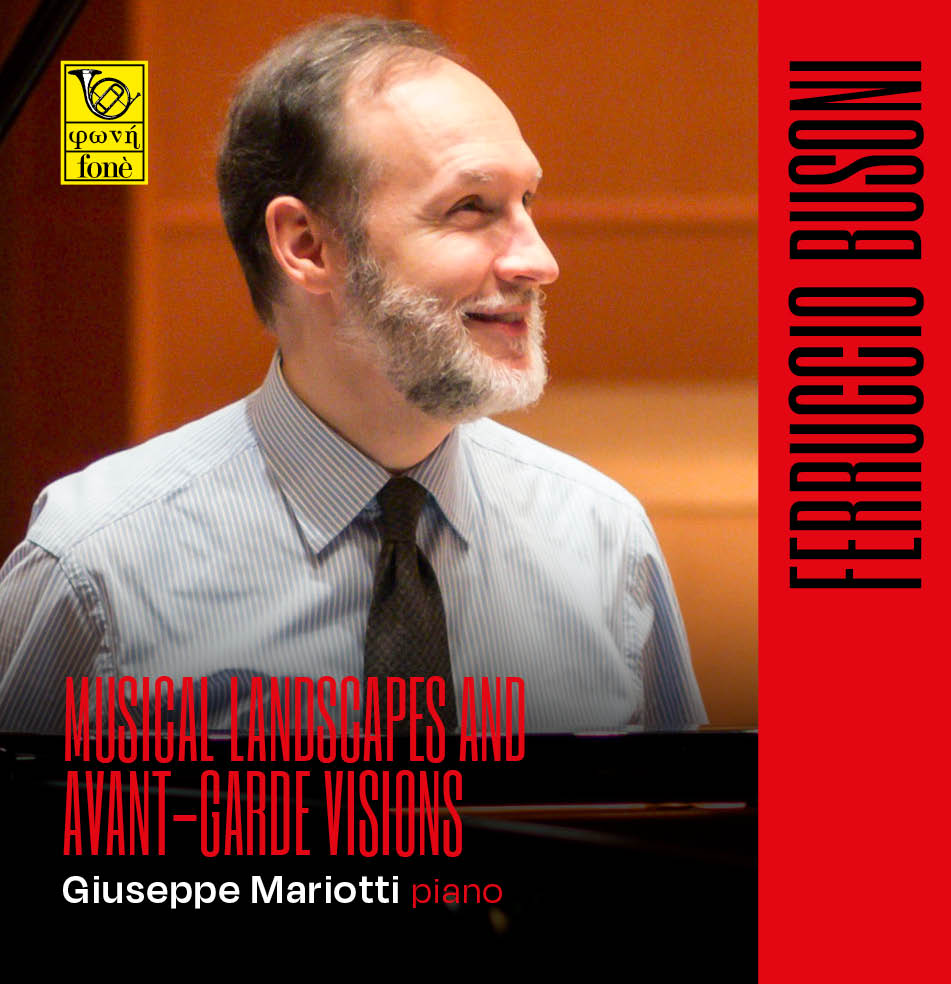
PAISAJES MUSICALES Y VISIONES DE VANGUARDIA | Busoni, Mariotti
Fonè
Genere musicale: Clásica
En existencias
No se pudo cargar la disponibilidad de retiro
SKU:DSD9511
MUSICAL LANDSCAPES AND AVANT-GARDE VISIONS
Ferruccio Busoni
Available in: DSD, Hi-Res Audio
Track list:
Suite Campestre Op. 18 Kind. 81 (1878)
1 Canzone Villereccia del Mattino
2 La Caccia
3 L‘Orgia
4 II ritorno
5 Preghiera della sera
6 Fantasia nach Johann Sebastian Bach Kind. 253 (1909)
Indianisches Tagebuch Kind. 267 (1915)
7 Allegretto affettuoso, un poco agitato
8 Vivace
9 Andante
10 Maestoso ma andando
11 Sonatina seconda Kind. 259 (1912)
12 Vierte Ballet-Szene Op. 33a Kind. 238 (1892)
13 Sonatina in diem nativitatis Christi MCMXVII Kind. 274 (1917)
Drei Albumblätter Kind. 289 (1917 - 1921)
14 (Zürich) Andantino sostenuto
15 (Roma) Andante
16 (Berlin) In der Art eines Choralvorspiels. Sostenuto religioso
Notes
Ferruccio Busoni's Leonardesque figure stands imposingly in the musical landscape at the turn of the two centuries. A frantic activity as a man and musician was the characteristic that accompanied him throughout his life, and his universal genius allowed him to reach absolute artistic peaks, even if often unrecognized. His virtuosity, impressive for speed and power but never showy or an end in itself, and his avant-garde and highly original musical imagination were legendary. From his youth, he was adored by the public, often leaving critics bewildered. His compositions, especially the later ones, are among the most significant and ingenious of his time: not only his piano works but also, and above all, those for orchestra and the operatic stage had a considerable influence on an entire generation of musicians. He genuinely endeavored to disseminate, through performances, revisions, and critical articles, the works of his contemporary composers (such as those of Arnold Schoenberg, who succeeded him in the composition chair at the Berlin Musikakademie). His literary background and subtle, acute mind allowed him to prepare librettos for his own operas and to maintain epistolary relationships with the greatest personalities of his time, in addition to publishing several fundamental writings. The most significant of these, the "Sketch of a New Aesthetic of Music" from 1907, contains ingenious insights into the dodecaphonic system, microtonality, new notation systems, and even hints of electronic music. He was also an inspirer of new instruments, such as the Viennese Bösendorfer Imperial model piano used for this recording, and originally built for him. The characteristic pieces of the Suite Campestre, composed at the age of twelve, clearly take Schumann's Album for the Young as a model. They reflect the late romantic idealization of rural life. In Preghiera della sera, certain mystical atmospheres emerge and a polyphonic writing of clear Bachian ancestry, elements so beloved by the mature Busoni. The Fantasia nach (after) Johann Sebastian Bach was composed in memory of his father Ferdinando. Although based on three organ compositions by Bach, about half of the piece consists of original material. The continuous alternation of minor and major sections well expresses both the emotional and tonal progression of the entire piece. The melancholy of the beginning turns into pacification at the end: the score significantly bears the inscription PAX EI! on the last page. The New World, visited several times during tours, held great fascination for Busoni. The songs and melodies of Native Americans left an indelible impression on him, leading him to compose a fantasy for piano and orchestra from which he drew the suite Indianisches Tagebuch (Indian Diary). The themes are almost literal transcriptions of Native American motifs, treated according to the schemes of Western music, yet with penta- and hexatonic inflections typical of those populations. The term Sonatina refers to the dimensions and form, not to their difficulty. The return to simple and clear compositional schemes (codified by Busoni in his idea of "new classicism") and the often intimate character of the Sonatinas are in clear contrast with previous compositions. The Sonatina seconda, almost an exception, represents his atonal experiment, following Schoenberg's example. New elements appear, such as the lack of bar indications for long stretches or a new way of understanding accidentals. The unstable, chaotic, brutal character reflects that of Umberto Boccioni's painting "The City Rises," owned by Busoni and from which he was inspired. The Sonatina in diem nativitatis Christi, with its calm, serene simplicity, perfectly represents the model of "new classicism." Christmas bells, Chorales, the mystical atmosphere, and also the pipers are inserted into a fine polyphonic texture, archaic and suggestive. The Vierte Ballett-Szene (Fourth Ballet Scene) of 1892 is almost a tribute to Johann Strauss and his Waltzes, in the sign of brilliant and salon virtuosity then in vogue. The last compositions are closely related to Busoni's unfinished opera, Doktor Faust, in which themes were often developed and matured in his piano works. The Drei Albumblätter (Three Album Leaves), thoughtful and melancholic, reflect the composer's state of mind after the horrors of the First World War. The first, algid and crystalline, displays refined harmonic solutions and a subtle, intimate rhythmic charge. The second, a fugato, is an extremely abstract and mysterious page, while the third returns to Bachian reminiscences with the chorale "Christ lag in Todesbanden" (Christ lay in death's bonds).
Giuseppe Mariotti
Share
-

Entrega de productos digitales
Información de entregaLos productos digitales se entregan a través del sitio y por correo electrónico con un enlace de descarga.
-
Escribe una reseña
Arriba puedes dejar una reseña del producto que has comprado. Nos encantará conocer tu opinión.
