

FLAUTA PARA CENAR - Ammendola, Benciolini, Candiotto, Casa, Degli Innocenti, Di Giorgio, Guglielmo, La Malfa, Nobile, Pavan, Sabbadin, Valerio, Bisi
Velut Luna
Genere musicale: Clásica
En existencias
No se pudo cargar la disponibilidad de retiro
SKU:CVLD248
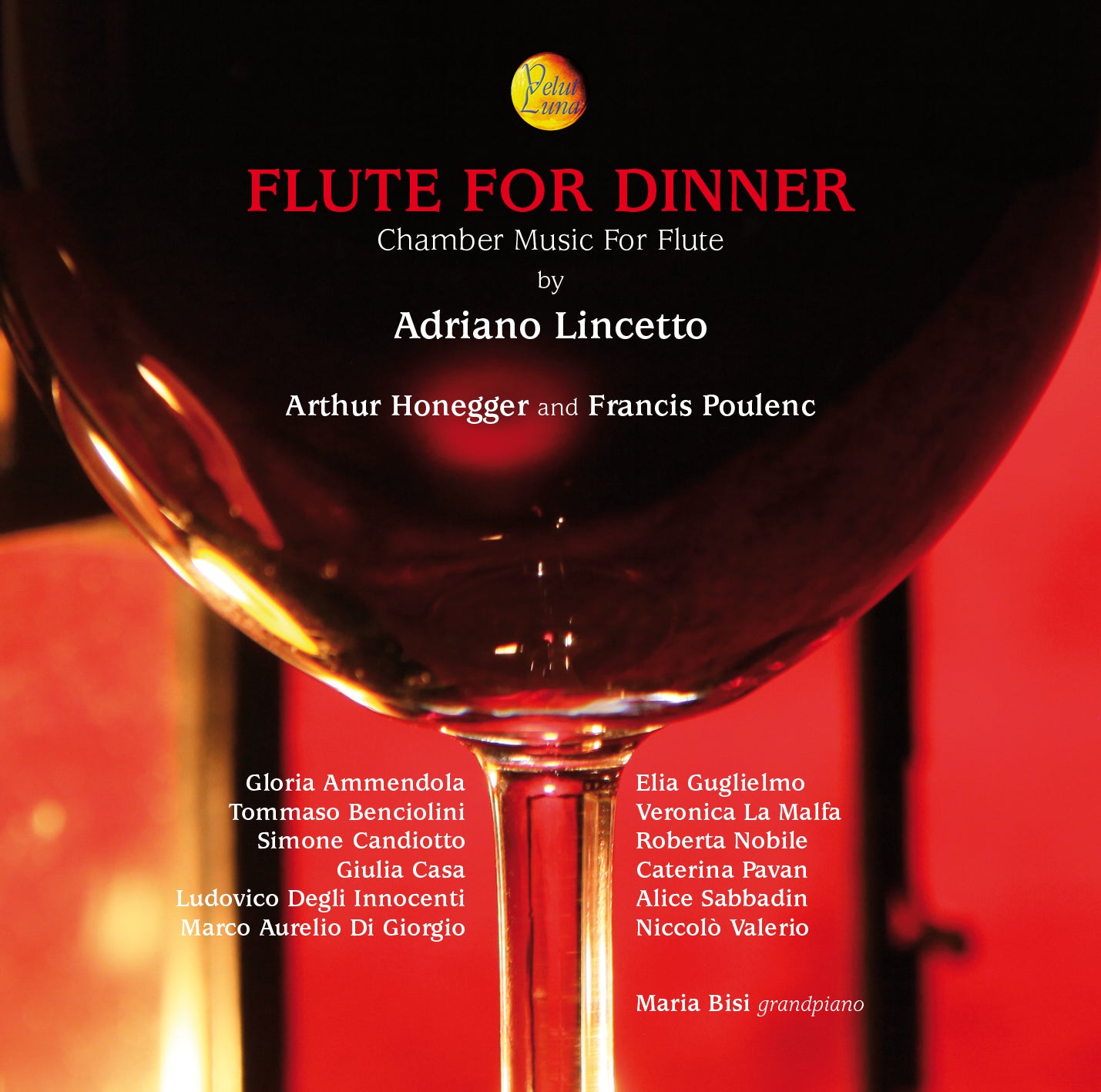
FLUTE FOR DINNER (CVLD248)
Composer: ADRIANO LINCETTO; ARTHUR HONEGGER AND FRANCIS POULENC
Performers: Gloria Ammendola, Tommaso Benciolini, Simone Candiotto, Giulia Casa, Ludovico Degli Innocenti, Marco Aurelio Di Giorgio, Elia Guglielmo, Veronica La Malfa, Roberta Nobile, Caterina Pavan, Alice Sabbadin, Niccolò Valerio; Maria Bisi ( grandpiano )
Tracks
Adriano Lincetto
Quartetto per flauti in do (1977) 12:16
01. Allegro deciso e molto marcato
02. Andante cantabile e sognante
03. Vivacissimo
Sonatina per flauto e pianoforte (1978) 9:41
04. Allegro spigliato
05. Andante elegiaco
06. Allegro ironico e grottesco
07. Sequenza per flauto solo (1979) 3:03
Giochi d’infanzia per tre flauti in do (1979) 4:39
08. Allegro spiritoso
09. Adagio ma non troppo
10. Scorrevole
Arthur Honegger (bonus track)
11. Dance de la Chèvre (1921) 3:27
Francis Poulenc (bonus tracks)
Sonata for flute and piano (1956) 11:44
12. Allegro Malinconico
13. Cantilena
14. Presto giocoso
Adriano Lincetto
15.Adagio e Allegro per orchestra di flauti (1982) 5:54
88.2 kHz / 24bit original recording made at Auditorium Pollini, Padova, Italy on December 11st, 12nd 2014
Production: Velut Luna
Musical producer and artistic direction: Daniele Ruggieri
Recording and mastering engineer: Marco Lincetto
Editing engineer: Matteo Costa
Cover and inside photos: Marco Lincetto
Design: L’Image
Marketing and Sales Manager: Patrizia Pagiaro
Note
Adriano Lincetto dedicated a significant part of his life to musical education and the promotion of young talents, in his role as a piano teacher, holding a professorship starting in 1966. This important training and didactic activity saw him as a protagonist at the "Cesare Pollini" Conservatory of Music in Padua for over 30 years: a conservatory that he also led with tenacity and stubbornness in the last 10 years of his life, before his premature death on April 24, 1996.
The flute is a very important and highly regarded instrument within the body of Adriano Lincetto's compositions. And a significant reason, perhaps the most important, leads us to refer to the primary inspirational source of the Paduan Master, which underlies all his compositions: his closeness to the performers.
It is well known, as the great Radu Lidijenko also highlights in his critical writings on the Master from Padua, that Lincetto undoubtedly wrote because he "could not not write": his was a primary need of his being an artist; but then, equally, writing for him also meant "giving" his music to his friends, or to his son Francesco, who, as it happens, was an excellent flutist. In this regard, it cannot be forgotten that a significant part of Adriano Lincetto's concert career as a pianist developed in the formation of the chamber duo with flute, with Enzo Caroli, in the 70s and 80s.
Therefore, most of the compositions on this album are written, conceived, and dedicated to these important... friends.
It is always difficult to talk about the compositional style of a distinctly independent author from the second half of the 20th century, free from the dictates of "schools" ("of the regime," allow me to add with a deliberate polemical spirit...). It is difficult because a sensitive and deeply cultured person cannot help but be influenced by the layers of a thousand and more years of previous musical literature. And this consciously, but certainly even more unconsciously.
It is therefore a daunting task for the "good critic" to try to identify and isolate these sources of inspiration. Lincetto was certainly enamored of the radical innovation brought to the world of music by two great revolutionaries such as Debussy and Stravinsky, whose manners and customs Lincetto sometimes quotes. But he was not insensitive either to the synthesizing ability of the great popular music of Eastern Europe achieved by authors like Bartok or Prokofiev.
Adriano Lincetto is certainly a child of the 20th century (although a fundamental composition for string orchestra from 1980, significantly titled "Suite per Paer," cannot be forgotten).
Delving further into detail, it is very interesting to note a strong need to communicate his vision of the notes written on the staff to the performer, even using words: the definitions of the individual movements and the agogic indications throughout the score are always illuminating and, I would say, striking. Taking the Sonata for flute and piano as a paradigmatic example, we can and must note the titles of the movements: Allegro spigliato, Andante elegiaco, Allegro ironico e grottesco. There is always an adjective to the classic definitions: very precise adjectives, which make the sensitive performer perceive the author's almost desperate need for his music to be fully understood. No less so are the agogic indications: "flowing, but marked" is written at the beginning of the third movement of the Sonata...
Here, the true great difficulty in translating Lincetto's compositions into sounds lies, even more than in the strict technical difficulty of correctly executing the notes, in being able to fully understand what the author, with so much imagination and stubbornness, tried to communicate with those notes, not disjoined from the words that further define them.
This communicative "anxiety," finally, distinctly separates the author from the frigid dryness of the great masters of the past, such as J.S. Bach, who, as is well known, left almost exclusively to the note written on the staff his entire artistic message (to the somewhat perverse delight of the many imaginative interpreters who over the centuries have engaged with the music of the great German author).
And also in this, Adriano Lincetto is not only a child of the 20th century, but also in some way a precursor of the twenty-first century, the century of great direct communication, the century of the internet and social networks.
I have always wondered how Adriano Lincetto would have experienced this new era and I have always answered myself that he would have had a lot of fun and perhaps would have found his most authentic natural "artistic habitat." Unfortunately, Adriano Lincetto prematurely passed away at the dawn of the new era, and all our curiosity is inexorably destined to remain unanswered.
Share
-

Entrega de productos digitales
Información de entregaLos productos digitales se entregan a través del sitio y por correo electrónico con un enlace de descarga.
-
Escribe una reseña
Arriba puedes dejar una reseña del producto que has comprado. Nos encantará conocer tu opinión.
