Ir directamente a la información del producto
1 de 1

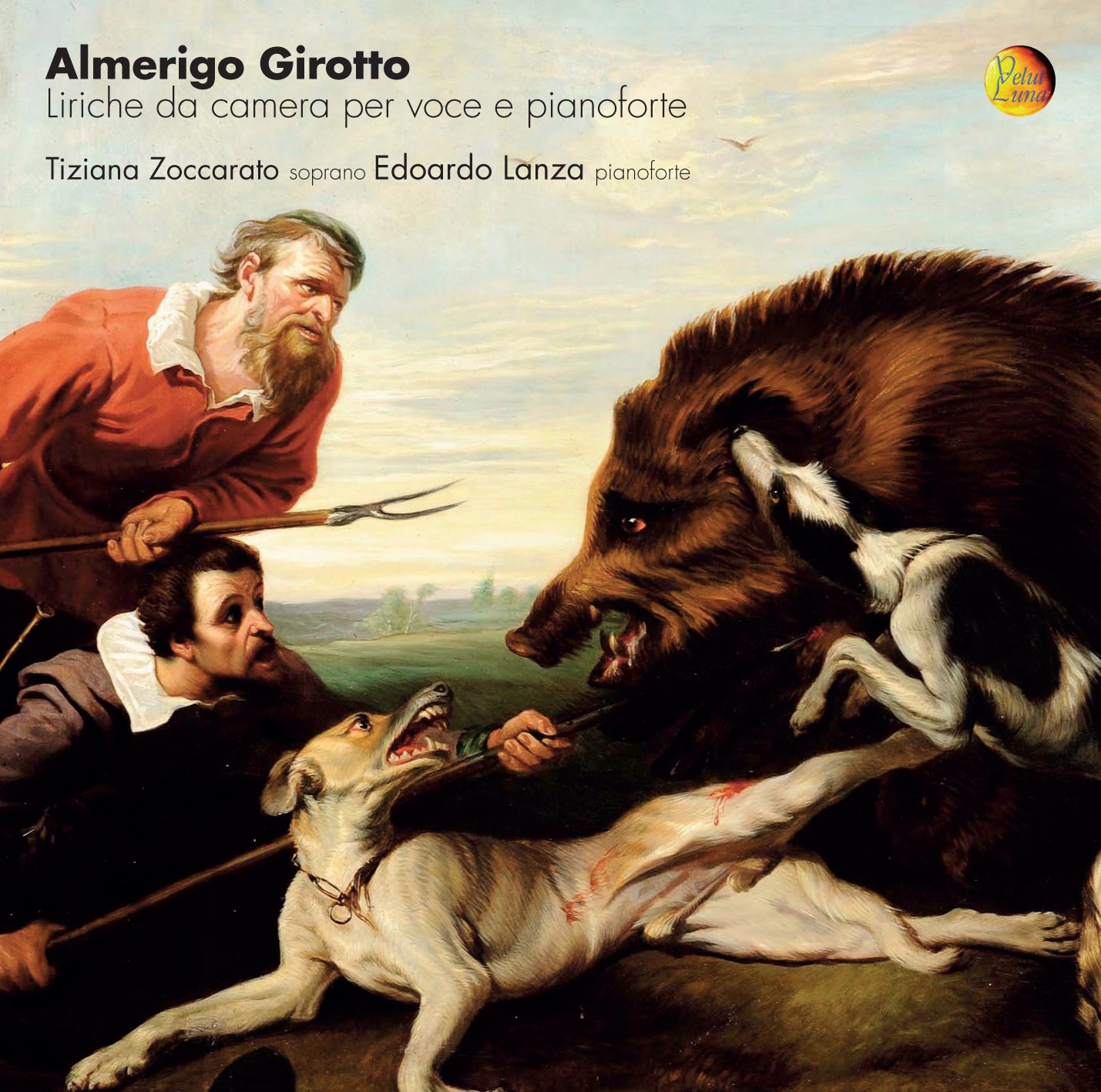
ALMERIGO GIROTTO, LÍRICAS DE CÁMARA PARA VOZ Y PIANO - Zoccarato, Lanza

Velut Luna

Genere musicale: Clásica

Precio habitual €18,00 EUR
Impuestos incluidos. Los gastos de envío se calculan en la pantalla de pago.
TAMBIÉN DISPONIBLE EN

En existencias

Cantidad

SKU:CVLD281CD

Add to wishlist Remove from wishlist

ALMERIGO GIROTTO, CHAMBER LYRICS FOR VOICE AND PIANO (CVLD281)

Author: Almerigo Girotto
Performers: Tiziana Zoccarato (soprano), Edoardo Lanza (piano)

Available in: HD File, CD

Tracks

Two Veronese Songs on Folk Texts
Conte Marin (6.53) / La Pastorela (4.27)

Four Suites on Veronese Folk Verses
Suite I: Allemanda (2.31) / Siciliana (2.19) / Corrente (2.14)
Suite II: Preludio (3.23) / Fughetta (2.16) / Intermezzo (1.13) / Bagatella (1.39) / Ostinato (1.22)
Suite III: Mattinata (2.19) / Cantilena (1.42) / Finale (1.29)
Suite IV: Introduzione (2.27) / Pavana (2.32) / Gagliarda (2.02)

Triptych on Verses by Neri Pozza
Epitaffio a Maria (3.08) / Nozze al plenilunio (3.33) / Togli dal volto le belle mani… (2.32)


TECHNICAL NOTES

24bit/88kHz original recording made at Area Magister Studio,
Preganziol, Italy on March 10th and June 1st, 2016

Edoardo Lanza plays Steinway & Sons D274 Concert Grand Piano
prepared and tuned by Silvano Zanta

Production: Velut Luna
Executive producer: Marco Lincetto
Musical producer: Edoardo Lanza, Tiziana Zoccarato
Recording, editing, mix and mastering: Marco Lincetto
Design: Limage
Photos: Marco Lincetto
English text: Patrizio Castelli

Note

ALMERIGO GIROTTO was born blind in S. Paolo, Brazil, in 1897, to Italian emigrant parents, but at the age of two, he was entrusted to his maternal grandmother in Vicenza. At nine, he was taken to the "L. Configliachi" Institute for the Blind in Padua, where he remained until 1914, also receiving his first musical education (Harmony and Organ) under the guidance of Luigi Bottazzo.
In 1941, prompted by the insistence of friends, he suddenly tackled, in a single session, the Fuga and Composition exams at the "Pollini" in Padua, passing them splendidly and with extreme ease. These were important achievements, but they lacked practical consequences, nullified as they were by his reserved character and a fatally integral pessimism (certainly not attenuated by the heavy wartime atmosphere), which conditioned not only the success of his works but even their simple recognition.
He had chosen to live almost always in Vicenza, a city to which he was bound by nostalgia and affection, and there, after the war, the rest of his life unfolded: a long wait, a dignified and conscious approach towards the great silence. Thus, in April 1967, his human voice fell silent, while that of song had already died many years earlier.
If Almerigo Girotto's life had a normal duration, his creative season, which took place roughly between 1925 and 1940, was very brief: a slow maturation, therefore, (which, if characteristic of many artists, in him is explained by the conditions of his life) followed by complete renunciation (and this is explained by his psychology).
Among the many enthusiastic opinions offered by his contemporary critics, we symbolically report here what Franco Abbiati wrote in the Corriere della Sera, the day after the concert held by illustrious performers at the Angelicum in 1947 (the year in which Girotto was also presented at the Venetian Festival of Contemporary Music): "his works for voice, for violin, for piano show a spiritual maturity and a constructive logic worthy of the best modern composers. Their content is often dramatic, their language often harsh and violent, their texture thins to chaste, slender, sweetly lyrical expressions…"

Considerations on A. Girotto's Lyrics for Voice and Piano
What is truly remarkable in Almerigo Girotto's compositions, and in particular in his lyrics, is the admirable combination of tradition and modernity, respectful classicism and highly personal originality, solid compositional technique and fresh melodic spontaneity, which effectively conveys the popular character of the Veronese dialect texts he set to music.
While maintaining a solid tonal framework, Girotto elegantly and effortlessly handles dense and dissonant harmonic combinations, sometimes distinctly polytonal, and employs varied, interesting, and appropriate rhythmic formulas and timbral effects.

Ver todos los detalles
  • Envío de productos físicos

    Envío gratuito a Italia y países de la UE en pedidos a partir de 95 €. Para Reino Unido, EE. UU., Canadá y el resto del mundo, consulta la política de envíos.

    Política de envíos 
  • Entrega de productos digitales

    Los productos digitales se entregan a través del sitio y por correo electrónico con un enlace de descarga.

    Información de entrega 
  • Escribe una reseña

    Arriba puedes dejar una reseña del producto que has comprado. Nos encantará conocer tu opinión.